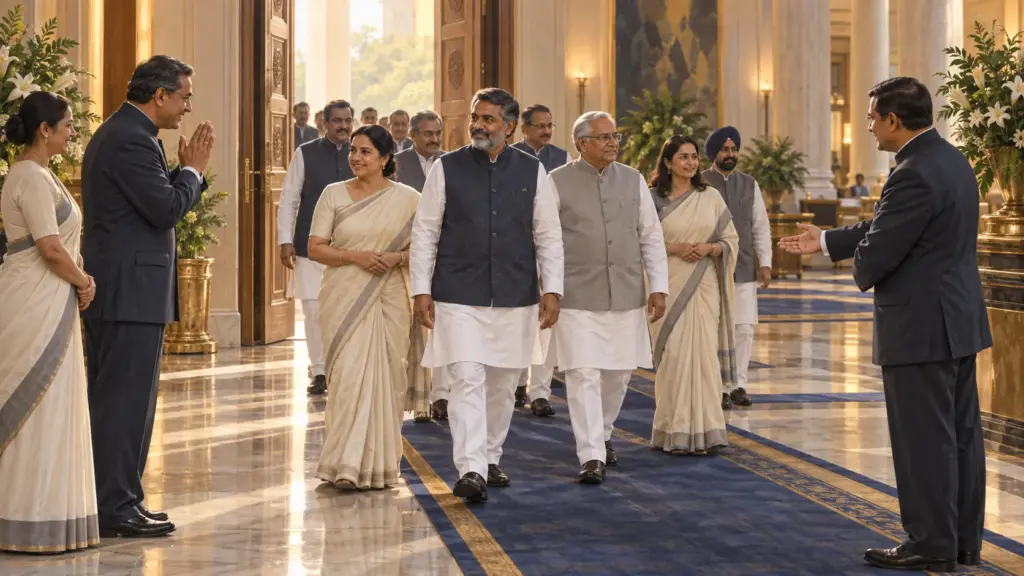

Both are elected representatives. Both are chosen by the people of a constituency. But they sit in different legislatures, make different kinds of law, and are the right person for very different problems.
The short version
- MLA: Member of the Legislative Assembly. Elected from an Assembly constituency to your state legislature.
- MP: Member of Parliament. Elected from a parliamentary constituency to the Lok Sabha, the national parliament.
You have one of each, and you elect them in separate elections, usually in different years.
Side by side
| MLA | MP (Lok Sabha) | |
|---|---|---|
| House | State Legislative Assembly | Lok Sabha |
| Elected from | Assembly constituency | Parliamentary constituency |
| Area covered | Smaller | Several Assembly constituencies |
| Normal term | 5 years | 5 years |
| Leader drawn from the house | Chief Minister | Prime Minister |
| Minimum age to stand | 25 | 25 |
A parliamentary constituency contains several whole Assembly constituencies, so an MP represents a considerably larger area and population than any one of the MLAs inside it.
Who makes which laws
The Constitution divides subjects into three lists, and this is what actually separates the two roles.
- Union List: Parliament legislates. Defence, foreign affairs, currency, citizenship, railways.
- State List: state legislatures legislate. Police, public health, agriculture, land.
- Concurrent List: both may legislate. Education, forests, criminal law.
So an MLA cannot change immigration rules and an MP cannot reorganise your state’s police force: not because of seniority, but because those subjects belong to the other house.
Which one should you approach?
As a rough guide, take local and state-administered matters to your MLA:
- Roads, water supply, drainage, street lighting
- State-run schools and hospitals
- Local policing concerns
- Land and revenue records
And national matters to your MP:
- Central government schemes
- Railways, national highways, passports
- Central legislation
In practice both hold constituency surgeries and both will route a genuine grievance to the right department. Approaching the “wrong” one is not a serious error: going to neither is.
The other kind of MP
Rajya Sabha members are also MPs, but you do not elect them. They are chosen by the elected members of state legislative assemblies, with a handful nominated by the President.
So when an election is described as electing MPs, it means the Lok Sabha. Rajya Sabha seats are never on your ballot, and this is one route by which someone can sit in Parliament without ever having won a popular vote.
Some states also have a Legislative Council, whose members are called MLCs. Most are elected by MLAs and by members of local bodies, but registered graduates and teachers directly elect about one in six, and the Governor nominates the rest.
Finding yours
Start by confirming which constituency you are enrolled in, then look it up in the constituency and representative directory on the main India वोट Kar site.
Correction, 24 September 2026: This article previously said members of Legislative Councils are all indirectly elected. Registered graduates and teachers elect about one in six of them directly, and the Governor nominates some.
Find your constituency, current representative and past results →