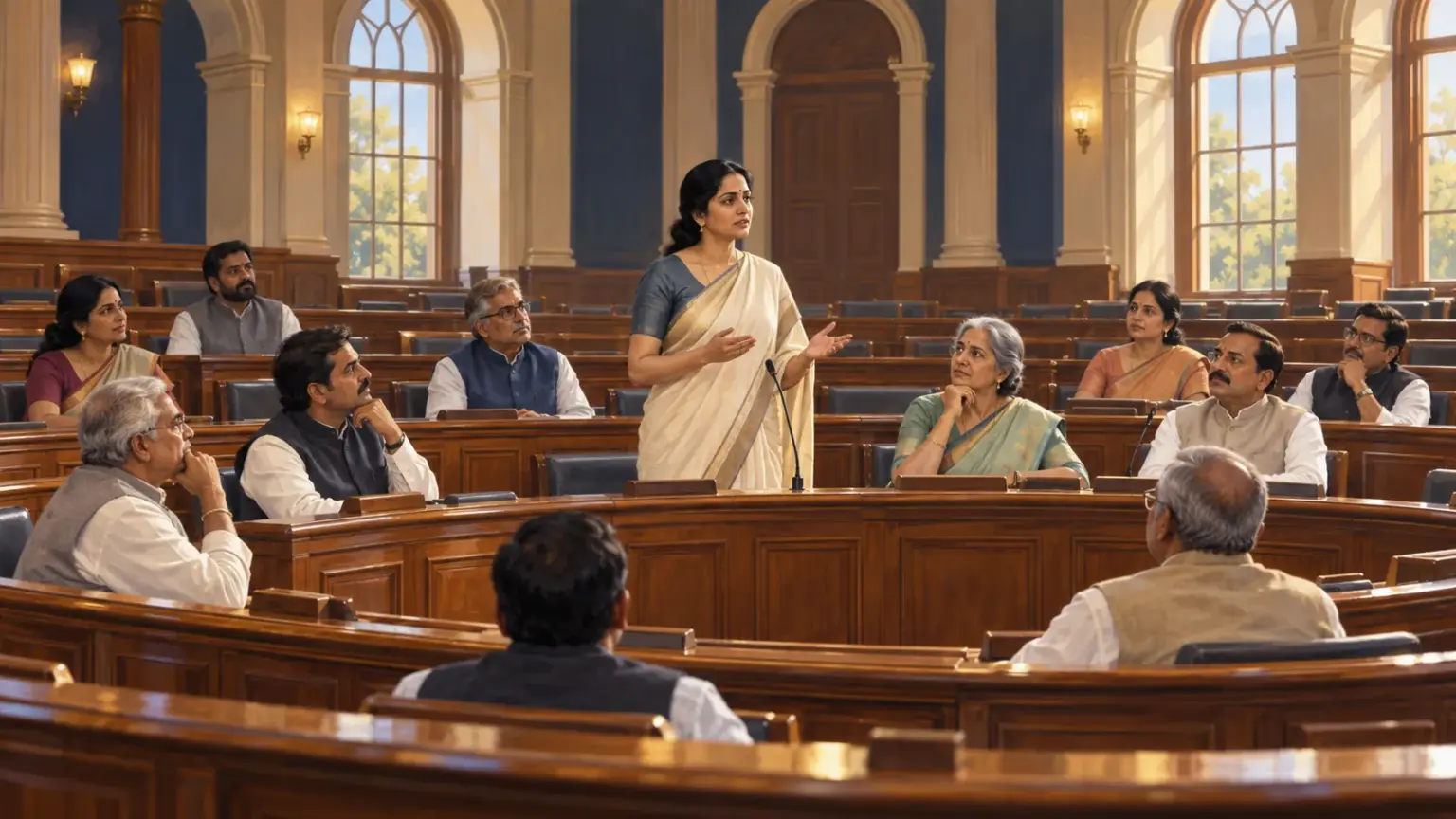
A Legislative Council, or Vidhan Parishad, is the upper house of a state legislature. Only six states have one, and its members are called MLCs.
Unlike MLAs, no MLCs are elected by all voters. Registered graduates and teachers vote for some of them; the rest are elected by MLAs and local body members, or nominated by the Governor.
The six states
As of September 2026, these states have two Houses:
- Andhra Pradesh
- Bihar
- Karnataka
- Maharashtra
- Telangana
- Uttar Pradesh
Article 168 of the Constitution, which lists them, also names Madhya Pradesh, whose council was never constituted, and Tamil Nadu, added by a 2010 Act that has never been brought into force. Jammu and Kashmir’s council was abolished in 2019.
Bills for councils in Rajasthan and Assam have been pending in the Rajya Sabha since 2013, as has a 2012 Bill to repeal Tamil Nadu’s 2010 Act, after its Assembly withdrew the request. The Odisha and West Bengal Assemblies asked for councils in 2018 and 2021 respectively, but no Bill has followed.
How a council is created or abolished
Under Article 169, the state Assembly must pass a resolution by a majority of its total membership and at least two-thirds of those present and voting. Parliament may then create or abolish the council by law.
That law does not count as a constitutional amendment under Article 368, so it passes like an ordinary Act.
Who sits in it
Under Article 171, a council may have at most one-third as many members as the Assembly, and no fewer than 40. They arrive by five routes:
- About one-third elected by members of local authorities, such as municipalities and district boards.
- About one-twelfth elected by graduates of three years’ standing living in the state.
- About one-twelfth elected by teachers with three years’ service in the state’s institutions of secondary-school standard or above.
- About one-third elected by MLAs, from among people who are not MLAs.
- The rest nominated by the Governor, for knowledge or experience in literature, science, art, the co-operative movement and social service.
These are the default shares. Parliament can set others under Article 171(2), and each state’s seats are fixed in the Representation of the People Act, 1950: Uttar Pradesh’s council of 100, for example, has 38 members elected by MLAs and 10 nominated.
These elections use proportional representation by single transferable vote, like Rajya Sabha elections.
Terms and eligibility
The council is permanent and never dissolved. Members serve six years, and about one-third retire every second year, under Article 172(2) and Section 156 of the Representation of the People Act, 1951.
An MLC must be at least 30 (Article 173). Under Section 6 of the same Act, an elected MLC must be a voter in any Assembly constituency of the state, and a nominated one must ordinarily live there.
The Supreme Court in Narayanaswami v Pannerselvam (1972) held that a candidate for a graduates’ seat need not be a graduate.
Limited powers
A Money Bill cannot start in the council, which must return it within 14 days with its recommendations. The Assembly may reject them (Article 198).
Other Bills from the Assembly can be held up for three months, and one month more if the Assembly passes them again; then they are deemed passed (Article 197). Unlike Parliament, where a joint sitting can settle a deadlock over a Bill (Article 108), a state legislature has no such procedure, so the Assembly has the last word.
Where voters come in
In council states, you can enrol in a graduates’ constituency if you have been a graduate of an Indian university, or held a notified equivalent qualification, for at least three years. You can enrol in a teachers’ constituency if you have taught for at least three of the last six years in notified institutions in the state of secondary-school standard or above. Both periods are counted back from 1 November of the year the roll is prepared, and you must be ordinarily resident in the constituency (Section 27 of the Representation of the People Act, 1950).
These constituencies have separate electoral rolls, so being on the ordinary roll is not enough. See how graduates and teachers register.
Everyone else takes part indirectly, through the MLAs and local body members they elect.
What MLCs do not vote for
MLCs have no vote for the President, because Article 54 limits the electoral college to elected members of Parliament and of state Legislative Assemblies. See how the President is elected.
Nor do they elect their state’s Rajya Sabha members: under Article 80(4), only the Assembly’s elected members do.
Find your constituency, current representative and past results →