
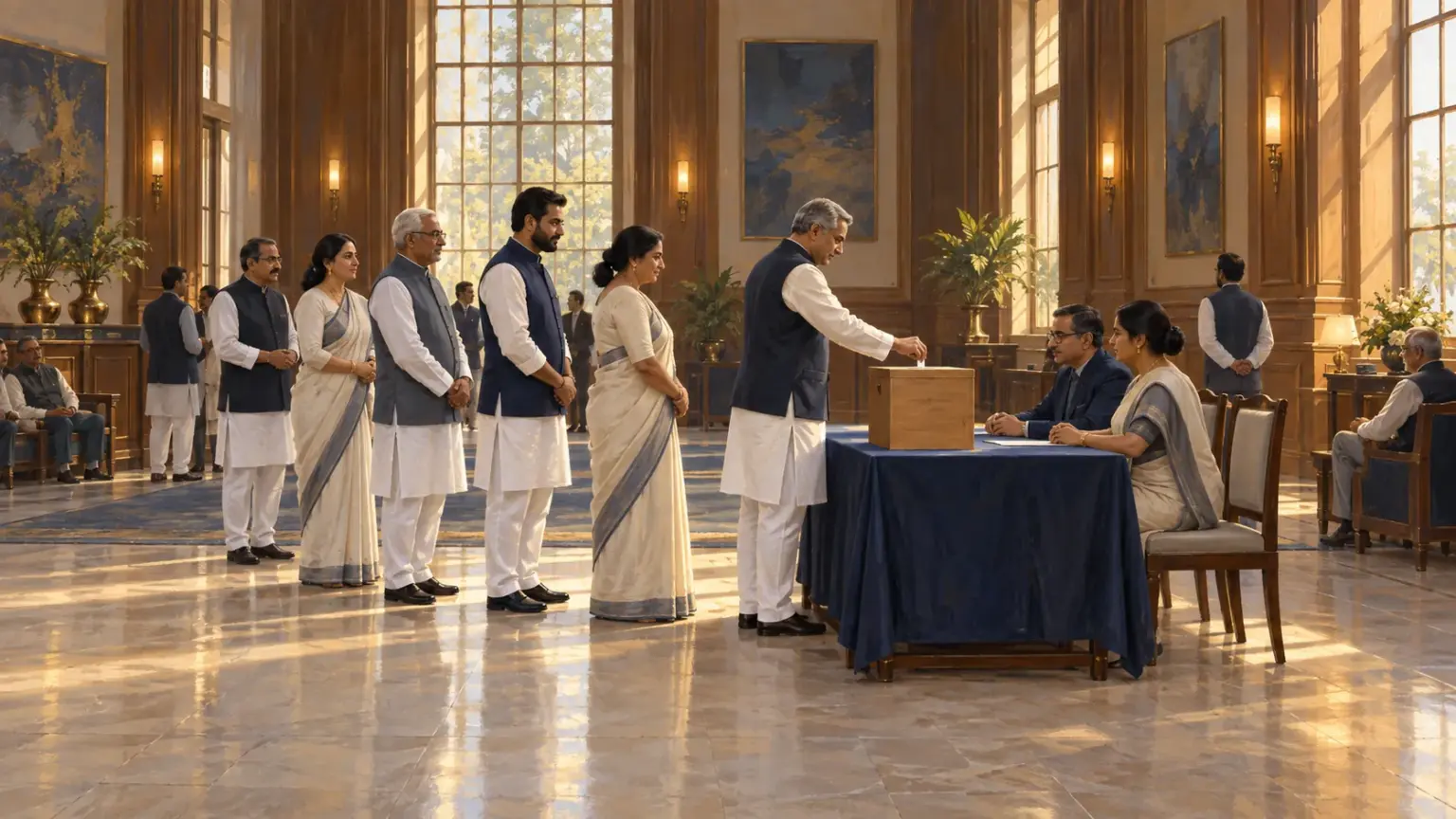
Rajya Sabha members are Members of Parliament, but you do not elect them. They never appear on your ballot. Understanding how they get there explains how someone can sit in Parliament, and hold high office, without ever winning a popular vote.
Who elects them
Most Rajya Sabha members are elected by the elected members of each state’s Legislative Assembly. Your MLA casts that vote on your behalf, which makes the composition of your state Assembly the thing that decides your state’s representation in the upper house.
Seats are allocated to states roughly by population, so Uttar Pradesh sends far more members than Goa. A separate group of twelve members is nominated by the President for distinction in literature, science, art and social service.
The house does not dissolve
Unlike the Lok Sabha, the Rajya Sabha is a permanent body. Members serve six-year terms, and about a third retire every two years.
This is why the two houses can be controlled by different sides at the same time, sometimes for years. The upper house reflects the state Assemblies of the past six years, not the most recent national mood.
How the voting works
Not first-past-the-post. Rajya Sabha elections use the single transferable vote with proportional representation.
MLAs rank candidates in order of preference. A candidate needs a quota of votes to be elected, derived from the number of voting MLAs and the number of seats being filled. Surplus votes above the quota transfer to the next preference, so a party with enough MLAs can reliably win a predictable number of seats.
Where parties hold exactly the seats the arithmetic implies, contests are often decided without a poll. Elections happen when someone gambles on picking up votes across party lines.
The open ballot
Your vote is secret. An MLA’s Rajya Sabha vote is not.
Since 2003 the ballot is open: an MLA must show their marked ballot to their party’s authorised agent before putting it in the box. The change was made to curb cross-voting for money.
There is a wrinkle worth knowing. Cross-voting in a Rajya Sabha election does not attract anti-defection disqualification, because the Tenth Schedule applies to proceedings of the House the member belongs to. Parties rely on the open ballot and internal discipline instead.
What the Rajya Sabha does
It reviews and can delay ordinary legislation, which must pass both houses. It cannot block a Money Bill, which the Lok Sabha ultimately decides, and it has no role in confidence motions: governments are made and unmade in the Lok Sabha alone.
Ministers, including the Prime Minister, may come from either house.
Why this matters when you vote
An Assembly election is not only about your state government. It also sets, for six years at a time, who your state sends to the upper house of Parliament.
Some states also have a Legislative Council, whose members, called MLCs, are mostly elected by MLAs and local body members, although registered graduates and teachers directly elect about one in six and the Governor nominates the rest. See MLA vs MP for how the directly elected roles compare.
Correction, 24 September 2026: This article previously said members of Legislative Councils are indirectly elected. Most are, but registered graduates and teachers elect about one in six directly, and the Governor nominates some.
Find your constituency, current representative and past results →