Counting day follows a fixed, public sequence. Understanding it explains why early “leads” swing wildly, and why the declared result can take hours to arrive after the first numbers appear on television.
Before counting starts
After polling closes, the machines are sealed and moved to a strongroom under guard, with candidates’ agents entitled to watch. The strongroom stays sealed, under surveillance, until counting day.
Counting happens on a single day for the whole election, even where polling ran in phases over weeks, so no declared result can influence voters elsewhere.
The sequence
1. Postal ballots
Postal ballots, service voters, election staff on duty, and other eligible categories, are taken up first. They are paper, counted by hand, and usually a small fraction of the total.
2. EVM counting, in rounds
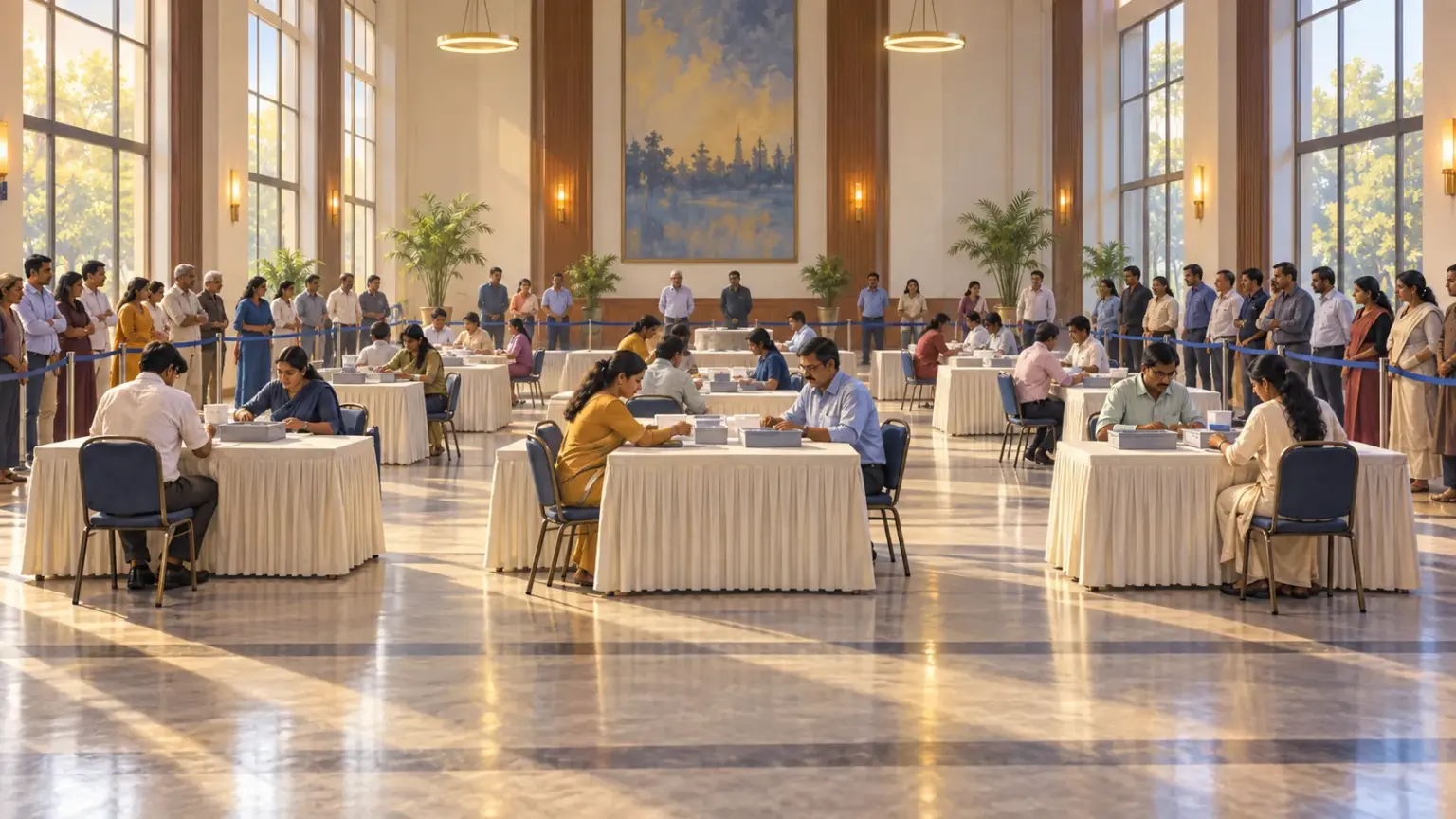
The control units are counted in rounds. Each round covers a batch of machines, the totals are tabulated and announced, and the next round begins.
This is why early leads are unreliable. Round one is a handful of booths from one part of the constituency, and areas differ. A candidate can lead for several rounds and lose, simply because their strongest booths were counted first.
3. Mandatory VVPAT verification
Before the result is declared, VVPAT paper slips are counted and matched against the electronic count.
Following a Supreme Court order of 8 April 2019, this is done for five randomly selected polling stations in each Assembly constituency, or each Assembly segment, in a Lok Sabha election. The stations are picked by the Returning Officer by draw of lot, in the presence of candidates and their agents.
Before that order, the requirement was one randomly selected station. Separately, under Rule 56(D) of the Conduct of Elections Rules, 1961, a candidate or their agent may make a written request for VVPAT slips of a particular station to be counted, which the Returning Officer decides by written order.
This hand-counting is a large part of why the final declaration lags the television numbers.
4. Declaration
Once counting and verification are complete, the Returning Officer declares the result and issues the winner a certificate of election. That declaration is the official result, not the media projection that preceded it.
Who is allowed to watch
Counting is not done behind closed doors. Each candidate may appoint counting agents who sit at the tables and observe every stage, alongside the Returning Officer, counting staff and Election Commission observers.
Objections are raised and recorded there and then. This is the structural safeguard: the process is watched throughout by people with opposing interests in the outcome.
Two things people get wrong
“Leading” is not “won.” Leads are partial counts from a subset of rounds. Until the Returning Officer declares, nothing is final.
Exit polls are not results. They are surveys, published after polling ends, and they have been wrong at scale. They are not part of the counting process in any way.
After the result
A declared result can be challenged only by an election petition in the High Court, within the statutory time limit. It cannot be reopened by the Election Commission once declared.
Constituency-level results, every candidate, their votes, NOTA, and the margin, are published by the Election Commission and are the authoritative record.
Find your constituency, current representative and past results →